 Layerswap
 Transfers, Swaps and Exchange Connections
Layerswap moves and exchanges crypto across supported blockchains, with transfer paths that also connect exchange balances to destination assets. Its app handles bridging and swapping, while embedded tools bring the same functions into other products. Available routes depend on the selected assets, networks and funding method.
Source balances, routes and destination assets
A funding source provides the tokens being sent, while a route connects that source to the destination network and asset. Wallet authorization covers spending from a wallet; an exchange withdrawal starts from the exchange account. The receiving address identifies where the destination funds belong. The selected network and token specify what can arrive there, so an address alone does not describe the complete transfer.
Embedded integrations place these functions inside wallets, decentralized exchanges and other applications.
Bridging and swapping across networks
Bridging moves assets between blockchains; token swapping exchanges one asset for another. Cross-chain swapping brings those purposes together when a route supports the chosen network and token combination. The transfer form includes source and destination networks, token selections, an amount and a receiving address. Support spans base-layer blockchains, rollups and application-specific chains, with availability determined by the selected route.
Exchange connectivity also covers transfers between supported chains and centralized exchanges. An available path into a network does not establish every possible path out. The source exchange must support the token and withdrawal network used to fund an exchange-originated transfer.
Funding paths and supported balances
Funding choices determine how source assets reach the service, with wallet, exchange and programmable options available in their supported contexts. Manual transfers use a supported deposit-address route without connecting the source wallet to the app, while an exchange-funded transfer requires a withdrawal from the exchange account using the chosen token and withdrawal network. Starknet and TON sources support only wallet-transfer funding.
The Depository supports contract funding on supported Ethereum Virtual Machine (EVM) networks and Tron. EVM funding covers native assets and ERC-20 tokens; Tron funding uses TRC-20 tokens. Separate Deposit Widget options accept supported app balances.
| Funding option | Source | Interface | Control and availability |
|---|---|---|---|
| Wallet transfer | Wallet balance | Wallet flow or API | Sender signs the supported source-network action |
| Deposit address | Wallet or exchange balance | App, Widget or API | Sender initiates payment; the source must support this method |
| Depository contract | Programmable wallet or contract | API funding | Caller submits contract funding; token approval may precede the deposit |
| Gasless deposit | Eligible source token | Widget or API | User authorizes the deposit; a relayer submits it and pays its network fee |
| Hyperliquid funding | Hyperliquid USDC balance | Deposit Widget | Requires EVM wallet support and a reachable destination |
| Polymarket funding | Polymarket balance | Deposit Widget | Account-owning wallet connects; EVM and Polymarket integration support and destination reachability are required |
| Offered options depend on source-network support, destination reachability and the integration settings that enable them. | |||
What determines a transfer quote?
A transfer quote prices a specific route and amount together with selected funding options and any optional destination gas top-up. Detailed pricing distinguishes fixed charges from percentage components. Network fees and exchange withdrawal charges can also contribute to the sender's overall cost.
A quote includes an estimated receive amount denominated in the destination token. The minimum receive amount applies the quote's slippage tolerance. These amounts describe expected output and its execution threshold, with the source amount denominated in the token being sent.
Optional Refuel reserves part of the source amount for native tokens on the destination network. Enabling it lowers the quoted primary receive amount while adding gas funds for later transactions. The feature's availability and top-up amount depend on the destination route.
Gasless quotes include the relayer cost on eligible routes; the relayer pays the network fee for the sponsored deposit.
Route coverage and amount limits
Supported network lists describe coverage, while available routes identify the source-token and destination-token combinations that the service can currently execute. Network support, providers and liquidity can change those combinations. A broad network catalogue therefore does not establish that every asset can move between every listed chain.
Minimum and maximum limits apply to source-token amounts for the selected route configuration; quote creation fails outside that range. Funding method, Refuel and destination address can affect those limits. Changes to these inputs require matching limits and quote information before funding; a limit from another route configuration may describe a different accepted amount range.
Source confirmation and destination settlement
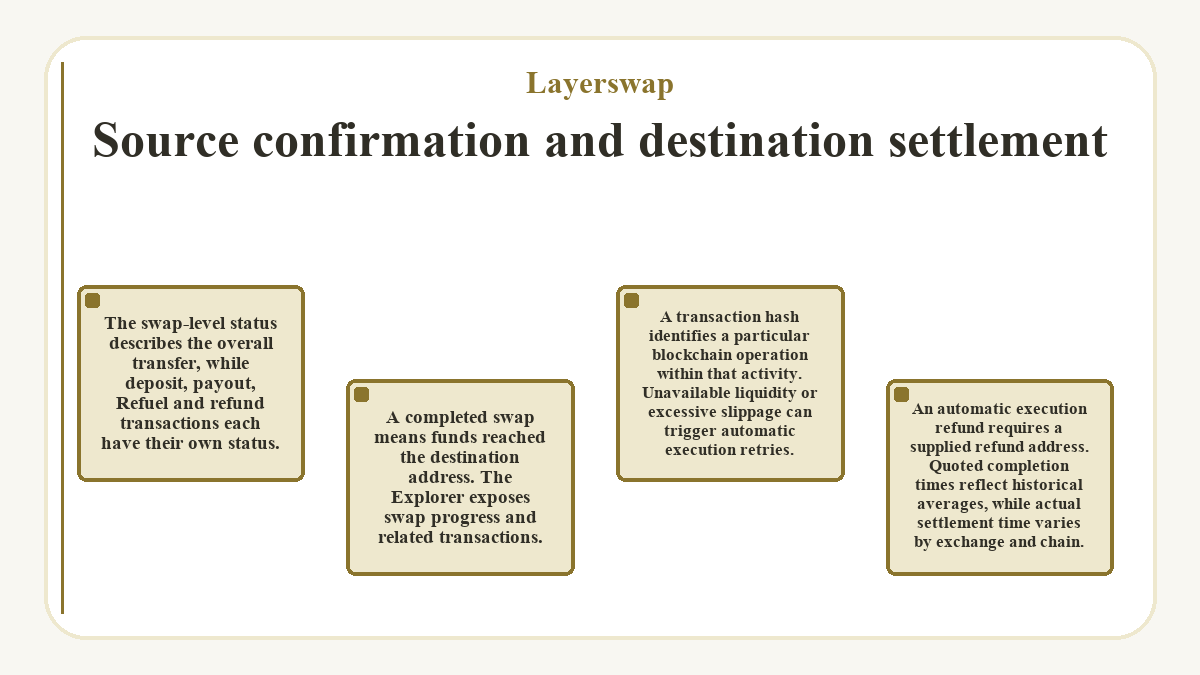
The swap-level status describes the overall transfer, while deposit, payout, Refuel and refund transactions each have their own status. A completed swap means funds reached the destination address.
The Explorer exposes swap progress and related transactions. A transaction hash identifies a particular blockchain operation within that activity. Unavailable liquidity or excessive slippage can trigger automatic execution retries. An automatic execution refund requires a supplied refund address. Quoted completion times reflect historical averages, while actual settlement time varies by exchange and chain.
Contract audits and Widget delivery
Security assurances apply to specific components, including the Depository contract and the software delivery path used by the Widget. Hexens audited the Layerswap EVM Depository smart contract. The audit concerns reviewed contract code within its stated scope. Integrations retain implementation and operational risks beyond that review.
The React and JavaScript loaders verify a signed manifest and integrity metadata before running downloaded Widget code. That verification protects the delivery path those loaders use. Recipient accuracy remains a separate concern: an executed blockchain transfer cannot be reversed to substitute another receiving address.
Embedded interfaces and integration control
The Swap Widget, Deposit Widget, Hosted Page and API expose related transfer functions with different control over the receiving destination and interface. The Swap Widget lets users choose a destination unless the integration locks it, while the Deposit Widget fixes the network and recipient and accepts only the destination tokens supplied by the app. Both Widget experiences share theming and callbacks.
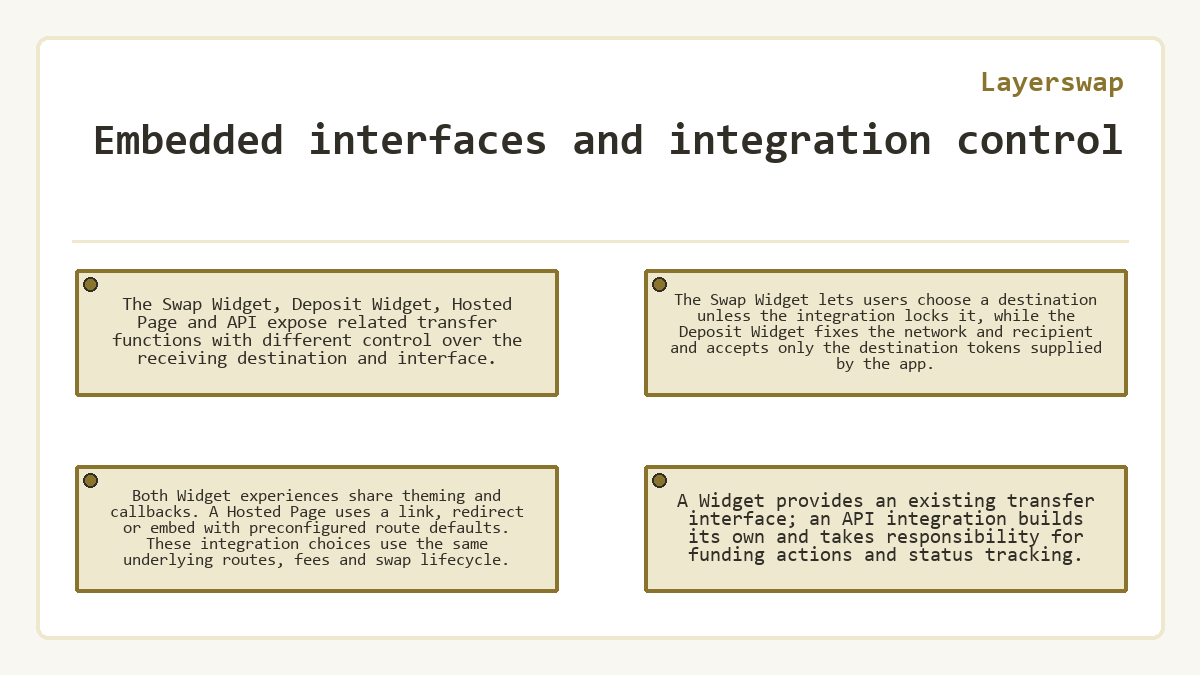
A Hosted Page uses a link, redirect or embed with preconfigured route defaults. These integration choices use the same underlying routes, fees and swap lifecycle. A Widget provides an existing transfer interface; an API integration builds its own and takes responsibility for funding actions and status tracking.
Questions people ask about Layerswap
-
How long does an unfunded swap remain open?
- A swap waiting for its source deposit expires after six hours if no deposit arrives. This expiry applies before funding, so it does not set the processing deadline for a funded swap.
-
What happens to a deposit below the route minimum?
- A source-token deposit below the applicable route minimum enters a failed state. This differs from execution failures that trigger retries, so below-minimum funding does not imply an automatic refund.
-
Will an execution refund equal the original deposit?
- An eligible execution refund returns source tokens on the source chain after gas deductions. No refund is issued if the refund amount is smaller than the gas fee. Automatic refunds after exhausted execution retries require a refund address; otherwise, the service keeps retrying execution.
-
Is the Deposit Widget the same as the Deposit tab?
- The Deposit Widget is a separate component with a destination fixed by the integrating app. The Deposit tab sits inside the Swap Widget and generates a deposit address or QR code; it can use the destination wallet connected by the user.
-
Which environment does an integration API key select?
- Mainnet and testnet API keys select their respective environments. Widget and API integrations require a key created through the Partner Dashboard. A testnet setup does not establish availability of a mainnet route.
-
Does Layerswap ask for a wallet private key or exchange password?
- Layerswap does not ask for account passwords or private keys. Wallet authorization occurs through the sending wallet, while exchange withdrawal controls remain with the exchange account. A receiving address identifies a payment destination; it is different from a secret that controls access to funds.
-
Why does a manual transfer still leave transaction records?
- Avoiding a source-wallet connection to the app does not erase the addresses and transaction information recorded publicly on a blockchain. Service use can also generate routine browser and activity logs.
-
Are there age or geographic restrictions on access?
- Access is subject to age, location and sanctions restrictions. The Terms of Services last modified on May 5, 2025 require users to be over 18 and exclude specified jurisdictions and sanctioned parties. Support for a network or exchange does not establish that every person can access the app.